Packaging Sampling & Prototype Planning
Packaging prototyping services should begin with a precise question: are you checking size, artwork, materials, assembly or the proposed production result? We coordinate sample requirements around that question. The sample route, scope, costs and timing are confirmed for each project, with clear limits on what each sample can prove.
From packaging idea to a reviewable brief
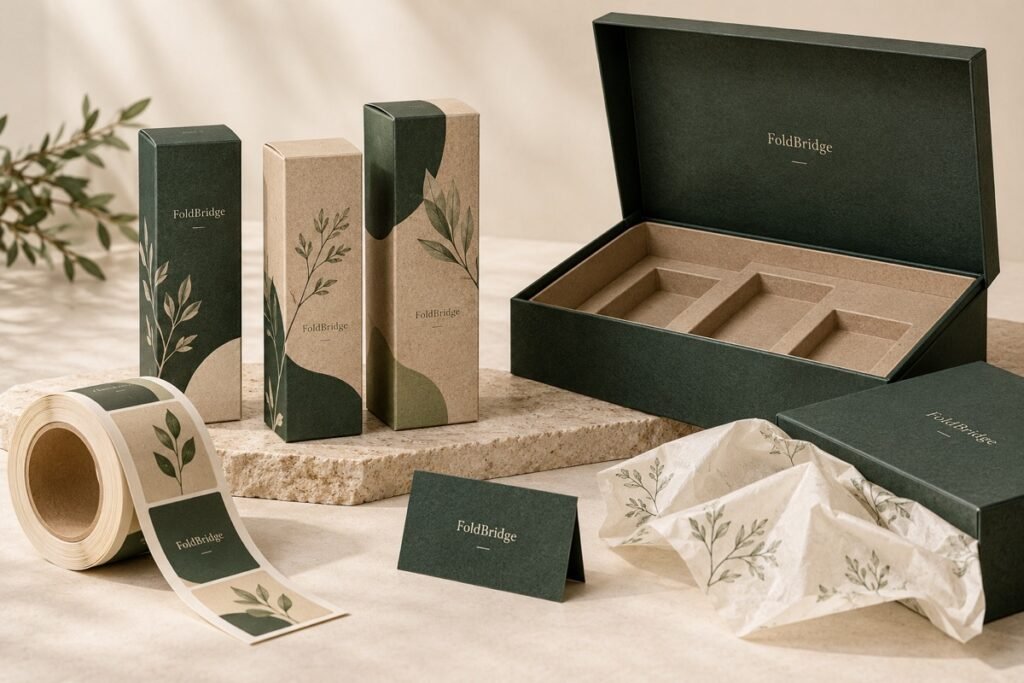
Use a visual reference to discuss the component family, opening experience and material direction. Approve dimensions, fit, artwork and the actual finish against a labeled physical sample.
A clear sequence for shared decisions
-
01
Identify revision
-
02
Check physical fit
-
03
Review print and finish
-
04
Record approval
Request the sample that answers the next decision
Swipe across the table to compare all details.
| Sample or proof | Useful for | Confirm its limitations |
|---|---|---|
| Digital artwork proof | Reviewing text, layout, placement and version. | It does not establish physical fit, paper feel or production color. |
| Unprinted structural sample | Reviewing shape, dimensions, assembly and product access. | Ask whether its material and construction match the intended production route. |
| Printed development sample | Reviewing appearance on a physical object. | Confirm which printing and finishing processes it represents. |
| Production-representative sample | Establishing an agreed reference before release. | Record represented materials, processes, revisions and any remaining exceptions. |
Make feedback usable for the next round
Send a representative product where the agreed sampling process requires it, or provide clear measurements and photographs for the initial review. Include the current dieline and artwork version if available. State when a measurement is approximate; do not let a rough input become an undocumented production assumption.
Separate comments by category: fit, function, appearance and information. Identify the location and effect of each issue, with a photograph or marked drawing where useful. A request such as 'make it better' is difficult to implement; a note such as 'increase finger access at the upper cavity' identifies a decision to resolve.
Record the revised sample identifier and what changed. If the sample uses a substitute stock or process, keep that difference visible. Approving the dimensions should not accidentally approve an unrepresented finish or an untested shipping configuration.
Questions before you commit
Are samples free?
Sample costs depend on the structure, materials, tooling, printing and delivery required. They must be confirmed in the project quotation. This site does not offer a universal free-sample policy.
Does a printed mockup guarantee the production result?
Only the agreed represented features can be treated as a reference. Ask which materials and processes were used and record differences from the intended production route. Resolve those differences before relying on the sample for a final release decision.
Do I need separate samples for structure and finishing?
Some decisions can be reviewed separately, provided their limits are recorded. A structural sample may establish fit while a material or finish reference guides appearance. Identify what each sample represents and decide whether an assembled production-representative sample is needed before release.
What information should accompany a packaging sample approval?
Record component name, drawing and artwork revisions, materials, sample type, review date and the person responsible for each decision. Note approved points and open issues separately. Make the approval traceable to the exact configuration, rather than relying on an unlabeled photograph.
Make the next decision with a clear brief
Share the product, quantity per SKU, destination and the questions still open. Specifications, costs and timing are confirmed after project review.