Packaging Materials, Printing & Finishes Guide
Packaging materials and finishes work as a system: the structural layer supports the pack, the visible surface carries the design, and printing or finishing changes its appearance and feel. Start with the product and use conditions. Then review the proposed combination on representative samples rather than treating a finish name as a complete specification.
From packaging idea to a reviewable brief
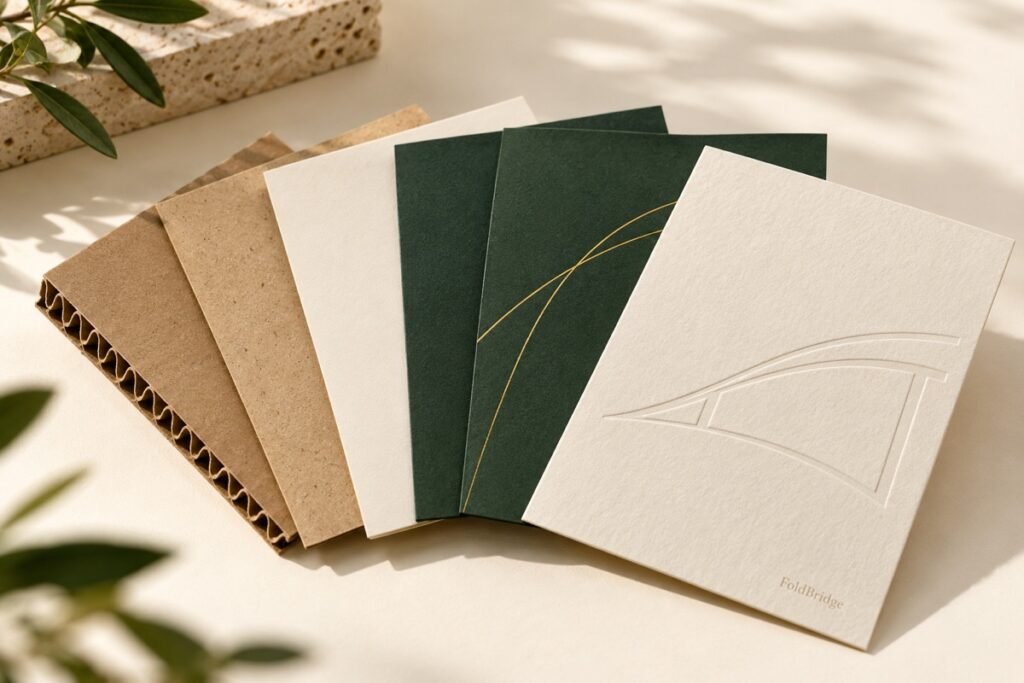
Use a visual reference to discuss the component family, opening experience and material direction. Approve dimensions, fit, artwork and the actual finish against a labeled physical sample.
Separate structure, surface and finishing
Swipe across the table to compare all details.
| Decision | Options to discuss | What to verify |
|---|---|---|
| Structural material | Paperboard carton, corrugated structure or wrapped rigid board. | Product fit, geometry, packing method and proposed production specification. |
| Printed surface | Coated, uncoated, kraft-style, textured paper or a label construction. | Appearance, print route and the actual sample reference. |
| Metallic accent | Foil applied to specified artwork areas. | Artwork separation, detail feasibility, position and physical appearance. |
| Raised or recessed detail | Embossing or debossing in a defined area. | Material suitability, tooling and the effect on adjacent graphics or folds. |
| Surface appearance | Matte, gloss, spot treatment or another proposed coating/film. | Complete construction, handling behavior and any relevant material evidence. |
Make each finish earn its place
Choose the part of the design that needs emphasis before selecting a process. A small metallic mark, a tactile feature and an overall surface finish each create different production requirements. Ask for separate options so you can compare their contribution to the finished pack and the quotation.
Identify the artwork layers required by the chosen route. Keep the current dieline separate from graphic elements and clearly mark special finishing areas. Exact file preparation requirements should come from the production route; do not apply an arbitrary universal bleed or line-width rule to every process.
Review color on the intended materials. A label and carton may share a visual direction while requiring separate physical references. Document the reference and the accepted appearance for each component. If the substrate or finishing route changes, decide whether the earlier visual approval remains valid.
Questions before you commit
Is paper packaging automatically plastic-free?
No. A paper-based package may include films, coatings, windows, handles or other components. Review the complete construction before making a plastic-free statement.
Can a digital proof approve texture or color?
It can support layout review, but a screen cannot establish tactile properties or the appearance of the finished material. Agree which physical sample or reference governs those aspects and record its limitations.
Can foil and embossing be combined on the same packaging design?
Include both effects in the artwork brief and ask about the proposed material and production route. Review their alignment, detail and placement together. Confirm feasibility and the relevant proof or sample before assuming that a digital rendering represents the available finish.
What evidence should support a recycled or recyclable packaging claim?
Define the exact component, material and claim first. Request applicable documentation from the proposed supply route and consider coatings, adhesives and other parts of the complete pack. Do not apply a broad environmental claim to the whole set based only on the appearance of one paper component.
Make the next decision with a clear brief
Share the product, quantity per SKU, destination and the questions still open. Specifications, costs and timing are confirmed after project review.